An update on Bredesen’s research
 Thanks to a special friend in the UK for alerting me to this via email: “Another amazing link worth watching , it’s a recent interview on CBN with Dale Bredesen, who is an international expert in neurodegenerative diseases.
 The interview covers discussion about the Bredesen Protocol which is successfully reversing cognitive decline in persons with MCI, and with Alzheimers and Dementia diagnosis’s. A recent Multi Author paper published last October shares the successes of the protocol involving 100 patients living with a Dementia diagnosis – well worth a read.
There is definitely something good going on here, which is offering a chance of real hope, improvement of symptoms and also prevention.
Sorry for the group email, but you know me, always keen to share positive news when I hear it.” (SHA)
I’m well aware there are many sceptics out there, but in reality, lifestyle changes and at least feeling healthier more generally are hugely beneficial outcomes for everyone, even if it doesn’t slow or reserves someone’s dementia.
In fact, a new study was published in the BRAIN journal recently that’s very good news for older persons, as many of the very same sceptics have been diagnosing older patients with Alzheimer’s Disease, it turns out, don’t actually have it. Interestingly these people are supportive of this research, yet scathing of some innovative research that may lead to even greater outcomes.
Preventing dementia
It may be too late, but I definitely recommend registering for this free session if you’re interested and available.
The more we learn about treating or preventing dementia differently, whilst the drugs trials continue to FAIL, the better in my opinion.
Moving beyond the failed science of curing dementia

This is a recent article about Professor Dale Bredesen’s Research. This and similar approaches are still the closest things I see to hope for those diagnosed in the early stages of dementia, or anyone wanting to reduce their risk of dementia.
Image source: screen shot from Dale Bredesen’s Facebook post
Living a good life with dementia: it is possible
 Living Well, Even With Alzheimer’s
Many people have the idea that Alzheimer’s disease is a one-way street to inexorable decline, but patients can remain active and engaged.
Seven years ago, Joe, a 73-year-old man with a patrician bearing, came to see me at my Manhattan office with his stylish wife and their grown daughter. (I’ve changed his name to protect his privacy.) Read the full article here…
Via David Kramer (thanks David!)
I just found this post in my drafts folder, having completely forgotten it was there!
It’s a great read, and whilst I’m not a big fan of the term ‘Living well with dementia’ I do know it’s possible to live a better life than patients are told to expect when diagnosed.
When we advance to late stage dementia, or cancer, or MND, or life, it’s not always much fun and almost always involves significant suffering. But as I wrote many years ago, why live like that now.
A Bredesen Protocol update

This is the latest paper from Bredesen and colleagues, published in the Open Access Journal of Alzheimer’s Disease & Parkinsonism. When searching for the article, I found many websites sharing it, and this one has negative comments about Bredesen and his protocol, alongside some very positive ones! As always, with new approaches to diseases (or anything), there are many doubters, including doctors, other health care professionals, and patients themselves. Personally, I have found taking a holistic approach to dementia, that included dietary changes, lifestyle and other changes such as increasing exercise, as well as rehabilitation to have been very helpful in slowing the progression of the symptoms.
Even if this novel – and non pharmaceutical – approach to managing and even treating a disease group, where we are no closer to a cure or disease modifying drugs than we were ten years ago only improves quality of life and well being, it surely is worth investigating! Potentially, it also reduces a person risk of many other co morbidities such as cancer, hear disease and diabetes.
Reversal of Cognitive Decline: 100 Patients
Bredesen DE, Sharlin K, Jenkins D, Okuno M, Youngberg W, et al. (2018) Reversal of Cognitive Decline: 100 Patients. J Alzheimers Dis Parkinsonism 8: 450.DOI: 10.4172/2161-0460.1000450
Abstract
The first examples of reversal of cognitive decline in Alzheimer’s disease and the pre-Alzheimer’s disease conditions MCI (Mild Cognitive Impairment) and SCI (Subjective Cognitive Impairment) have recently been published. These two publications described a total of 19 patients showing sustained subjective and objective improvement in cognition, using a comprehensive, precision medicine approach that involves determining the potential contributors to the cognitive decline (e.g., activation of the innate immune system by pathogens or intestinal permeability, reduction in trophic or hormonal support, specific toxin exposure, or other contributors), using a computer-based algorithm to determine subtype and then addressing each contributor using a personalized, targeted, multi-factorial approach dubbed ReCODE for reversal of cognitive decline.
An obvious criticism of the initial studies is the small number of patients reported. Therefore, we report here 100 patients, treated by several different physicians, with documented improvement in cognition, in some cases with documentation of improvement in electrophysiology or imaging, as well. This additional report provides further support for a randomized, controlled clinical trial of the protocol and the overall approach.
Download the full article here or from the Journal website
Learn to live beyond the ordinary
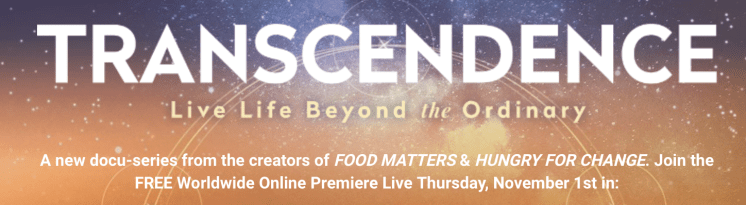 The following is the content of an email I received recently from Mark Hyman MD, highlighting a series on holistic approaches to health. With no cures on the horizon for any type of dementia, it seems for now, the very best we can do is to manage our whole of health well.
Perhaps we should be doing that for almost ALL health conditions anyway, rather than rely on the pharmaceutical industry for their often expensive, and what are usually very toxic quick fixes anyway???? Just a thought…
“Every now and then I like to share new wellness resources with you, ones that I think will become a valuable part of your own library and support your journey to optimal health.
That’s why I’m writing to you today, to share a new 5-part docu-series that explores the current state of our physical, emotional, and mental health in a captivating way. It’s called Transcendence – Live Life Beyond the Ordinary, and it’s from the same internationally renowned filmmakers―James Colquhoun and Laurentine ten Bosch―who produced Food Matters and Hungry for Change.
They’re so excited and passionate about inspiring change through the stories in this amazing series, that they have made the worldwide online premiere completely free.
You can save your free spot for the Transcendence premiere, starting on November 1st, right here.
I am thrilled to be one of the speakers in this profound docu-series, along with some of the world’s most recognized doctors and thought leaders, like Jim Kwik, Gabrielle Bernstein, Joe Dispenza, and Marie Forleo, just to name a few.
Each of the 5 fascinating episodes individually tackle some of the biggest challenges of our time, including:
- overcoming stress
-
depression & anxiety
-
healing autoimmune conditions and chronic illness naturally
-
releasing fear & limiting beliefs
-
plus, uncovering more purpose and fulfillment in life
And, when you save your free spot today, you’ll get instant access for the first 12 minutes! Transcendence will take you on a journey into “self” like no other docu-series before it. I hope you’ll join me for this inspiring series on how to live a better life.
Wishing you health and happiness,
Mark Hyman, MD”
uMETHOD
 It’s been a long time between water holes since I was here, as they say in the desert!
“
”
Check it out… https://umethod.com/individuals-memory-loss/
Reinvesting in life is the best prescription
 It’s been a while since I published anything here… but I have been reminded of an article I wrote a few years ago for the Australian Journal of Dementia Care today, which is about ditching the Prescribed Disengagement® given to most of us when diagnosed with dementia, and Living Beyond Dementia™ instead.
Reinvesting in life is the best prescription
When Kate Swaffer was diagnosed with younger onset dementia, she was advised to give up work, study and life as she knew it, put her affairs in order and investigate aged care options. Instead, she ignored this ‘Prescribed Disengagement™’, as she terms it, and reinvested in life – something she recommends to everyone who has been diagnosed with dementia.
Subsequent to my being diagnosed with frontotemporal younger onset dementia in 2008, at the age of 49, health care professionals and service providers all told me the same thing: to give up work, give up study and go home and live for the time I had left. On the way, it was also suggested I put my end-of-life affairs in order – even though at no time was I told dementia is a terminal illness – and to get acquainted with aged care, including selecting a respite day care and residential care facility, sooner rather than later, so I could become used to it. My husband was told he would soon have to give up work to become a full-time carer.
Read the full article online here…
Transcendental Meditation and Dementia
Anyone who follows this site knows I have been a believer in Bredesen’s Protocol, although I do have some healthy scepticism as well! In saying that, I believe if we don’t view dementia as a chronic disease, which brings with it acquired cognitive disabilities, the estimates of people being diagnosed may be much higher than currently projected.
We must manage dementia as a chronic progressive condition, with healthy lifestyle changes, add in rehabilitation (cognitive and physical), and recognise the value of neuroplasticity; if society, governments, health care professionals and service providers fail to do so, they are also failing the 50 million people currently living with dementia, and the expected 131.5 million expected to have dementia by 2050. We all have a right to Universal Health Coverage.
A recent announcement on the TM website A New Collaboration in the Fight Against Alzheimer’s: The Bredesen Protocol and the Transcendental Meditation Technique from Dr. Dale Bredesen, Professor of Neurology at UCLA and an internationally renowned expert on Alzheimer’s, and who released his book, The End of Alzheimer’s: The First Program to Prevent and Reverse Cognitive Decline, discusses the value of Transcendental Meditation® for people with dementia.
Dr. Bredesen documents the effects of a comprehensive treatment—known as the Bredesen Protocol—designed to prevent and reverse the effects of cognitive decline associated with Alzheimer’s.
Now, the TM technique is being integrated into this protocol. This is based on published studies on TM showing improvements in neuro-plasticity and global brain wave (EEG) coherence, associated with improved cognitive performance, intelligence, and memory, as well as significant reductions in stress and anxiety.
In the following introductory video, Bob Roth describes the Transcendental Meditation® technique in depth, and the value of the technique. As a TM practitioner since I was 21 years old (now for 39 years!), I am totally committed to this twice daily practice, and believe it has increased my capacity to remain resilient and optimistic, in spite of the many personal crises and numerous serious health issues I have faced.
 Living Beyond Dementia™